
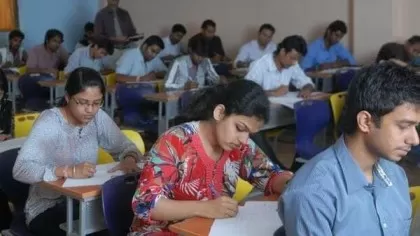
The NEET PG 2026 examination was held today, August 30, in a single shift - from 9 am to 12:30 pm with around 2.73 lakh medical graduates appearing at 1,111 test centres across the country. 2,445 candidates will reappear for the test on September 5 as the examination could not be conducted due to internal power supply issues at the centre.
NEET PG 2026 Paper Analysis, Difficulty Level
According to experts, around 20 questions were easy and another 20 were difficult, while the remaining questions were of moderate difficulty. They said students are likely to secure an All India Rank (AIR) 1 if they score above 640 marks in the NEET PG examination.
Dr Priyansh Jain said a large number of students are expected to be clustered in the range of 120 to 130 correct answers. He added that negative marking could play a crucial role in determining the final ranking and serve as a potential tiebreaker among students with similar scores.
Speaking about the topics covered in the question paper, Jain said several basic concepts were tested, including urea cycle disorders (UCDs), the electron transport chain and arachidonic acid. He noted that there were only a few one-line or direct questions.
He further said the paper included a significant number of questions focused on investigations and treatment, while diagnosis-based questions were comparatively fewer.
The expert also highlighted the presence of several image-based questions, including questions involving staging through figures. He said the paper featured multiple images related to conditions such as adenomyosis and leiomyoma.
The section-wise time restriction made pacing particularly important. Unlike an examination in which candidates can freely move across the entire question paper, the sectional format required students to complete each section within its designated time.
On time management, Jain said students likely did not face any major difficulty, particularly as the number of questions had been reduced from 200 to 180. He said the questions were expected to be lengthy ahead of the examination, and while some were indeed lengthy, several others were relatively easy, giving students additional time to complete the paper.
Speaking about integrated questions, Jain said Medicine was extensively integrated with Pharmacology. He added that the paper also included applied Physiology and hypothetical questions, requiring students to apply concepts rather than simply recall facts.
Jain described around 70 to 80 questions as tricky or confusing. However, he said none of the questions were outside the NEET PG syllabus, although there could be one or two questions from topics that students did not expect.
High Number of Image-Based Questions
He further estimated that around 50 of the 180 questions were image-based. On the easiest subjects, Jain said Biochemistry was among the easiest, while Medicine was also manageable for students.
According to Jain, the paper had a greater focus on approach-based questions, such as asking candidates what their next course of action would be in a hospital setting.
Overall, he described the paper as moderately difficult. On a scale of 0 to 10, he rated its difficulty at around 6.8.
Student Reactions
Students termed the paper of moderate difficulty and said no video based questions occured. Meenu, NEET student said "rote-learning would not have helped," as the paper had several practical-based questions.
ALSO READ | NEET PG 2026 vs 2025 Exam Analysis: Which Paper Was More Difficult?
NEET PG 2026 Paper Analysis: Overall Difficulty
- Paper Difficulty: Moderate
- Paper length: Less Questions Compared To Last Year
- Mode: Computer-based test
- Total questions: 180
- Maximum marks: 720
- Duration: 3 hours 30 minutes
- Marking scheme: +4 for every correct answer, -1 for every incorrect answer
Read More | NEET PG 2026 Exam Delayed at Sitapura Jaipur Centre After Power Outage




![[Link Active] RRB NTPC UG CBT 2 Answer Key 2026 LIVE: Download CEN 07/2025 Response Sheet PDF](https://img.jagranjosh.com/images/2026/September/2492026/RRB-NTPC-UG-CBT-2-Answer-Key-2026.jpg)